Psychology as Religion: The Cult of Self-Worship by Paul C. Vitz
by: Johnny Kicklighter
It seems everyone you meet these days is a self-proclaimed psychologist. From radio talk shows, television interviews, romance novels, weekly magazines, to cliques at work; everybody has an opinion on the latest “mental illness.” I was first introduced to practical psychology when I joined the United States Air Force in 1970. It was expected that Non-Commissioned Officers (NCOs) would become counselors to their subordinates. Profession military education devoted entire chapters and lectures on non-directive or eclectic counseling techniques. Maslow’s hierarchy of needs was drilled into our heads. We were sternly warned to avoid any mention of religion, but instead to make ample use of psychological techniques.
Paul Vitz in his book “Psychology as Religion” attempts to expose psychology for what it really is, i.e., religion. He begins by giving the reader a brief biography on the fathers of the modern psychology movement along with some of their theories. The opening chapter was dry reading but I suppose necessary as a historical backdrop. My interest peaked when I immediately recognized Carl Rogers and Abraham Maslow since I was forced to study them for 26 years while in the military. Vitz also discusses Carl Jung, Erich Fromn, and Rollo May as being significant contributors to the movement.
 Vitz quickly transitions into explaining the concept of self-esteem which he promotes as the center of the entire selfism movement. This became important to me as it seems no matter where you turn, a lack of or poor self-esteem appears to be the cause of every ill known to mankind. For a movement to be so widespread to the point where psychology has been woven into the gospel message, Vitz says that the self-esteem concept has “no clear intellectual origins.” That’s a surprising claim considering the impact selfism has had on academia and the practice of counseling.
Vitz states that self-esteem should be understood as an emotional response and not a cause. He says it is a reaction to what we have done and what others have done to us. High self-esteem is a desirable feeling to have (like happiness), but the feeling itself isn’t the cause of anything. In trying to obtain a feeling of self-esteem, the only successful way is to do good to others or accomplish something. In so doing, you’ll get all the self-esteem you want. However, the downside is people begin to pursue happiness as a far greater goal than the goal of obtaining personal holiness.
Not only is selfism a self-defeating goal for the Christian, Vitz goes on to make the case that it is also simply bad science and a warped philosophy. The little clinical evidence that does exist is mostly based on empirical observations and doesn’t stand the test of solid scientific problem solving. He exposes flaws in each step of the process, from stating the problem, forming and testing the hypothesis, to testing the conclusion. He also identifies several philosophical contradictions and in some cases, actual misrepresentations. The spread of this bad science and faulty philosophy is believed by the author to have contributed to the destruction of families. Additionally, the entire recovery group mentality convinces the person with “low self-esteem” that their ills are due to trauma inflicted on them in the past. Recovery group therapy strokes the patient with self-pity thereby convincing the clients are victims. Once labeled, the “victim” now assumes the attitude of victimhood.
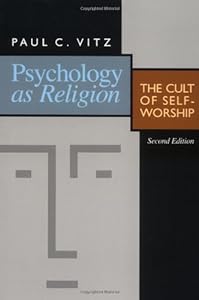
Cover via Amazon
Values clarification has become the model taught in schools and begins with the assumption that man is naturally good. Since the developers of values clarification reject moral teachings, Vitz claims that if responsible adults, i.e., teachers, don’t promote good values then someone else will. Providing a permissive environment supposedly nourishes the child by granting satisfaction for the child’s desires and interests. However, this philosophy is bankrupt because kids will assume the values of irresponsible sources in lieu of responsible ones. This combined with the aforementioned teachings has produced a society of victims where everyone is pointing to blame someone else for their misfortunes.
Vitz takes three chapters to present a Christian analysis and criticism of humanistic self-theories. He gives the credit to our educational system for the transformation of our society into a culture of pure selfism. He notes that the New Age movement has many founders, but Abraham Maslow’s theories have been the most influential. Vitz argues his Christian critique within a historical framework and the impact it has had on the evolution of our society. Unfortunately he gives scant attention to biblical references for his position, but does show how the selfism heresy affects teachings on depression, idolatry, and suffering. He closes his work with the observation, “never have so many people been so self-conscious, so aware of the self as something to be expressed…., the self has become an object to itself.” (I think this may make the case that self-esteem has become a new barometric indicator to the question everyone asks, “How are you doing today?”)
Overall, Vitz’s book uses a cerebral approach in attempting to prove that self-worship is simply a religion. Biblical counselors looking for material to help their counselees break free of a selfish worldview of life will be disappointed. Then again, Vitz didn’t write his book for that purpose. Moreover, he provides a wealth of information and a refreshing argument against those who say, “You can’t teach religion in public schools.” This leaves the reader with an irony: it’s not a question of should we or should we not teach religion in public schools, but instead, what religion will we teach; selfism or Christianity?
The post The Cult of Self-Worship appeared first on Robert JR Graham.
Overcome Your Fear of Public Speaking
“The Secret” of Personal Change
Confront Your Fears and Grow
Considerations Before Marriage
Sharing As Equals in A Relationship
Powerful Steps to Master Public Speaking
